Florida updates its building code every three years, and the 9th Edition takes effect on December 31, 2026. If you own or manage a commercial building and have roof work on the calendar for the next few months, the date matters more than it usually would, because the edition that applies to your job generally depends on when the permit application is filed.
The permit date decides which code applies
Engineers reviewing the new edition note that permit applications filed before the effective date are generally reviewed under the current 8th Edition (JRH Engineering). Building departments can differ on the details, so confirm with the office that will issue your permit. For a roof replacement planned for early 2027, a few weeks either side of December 31 can change which rules the design has to follow.
Recovering a roof that already has two layers
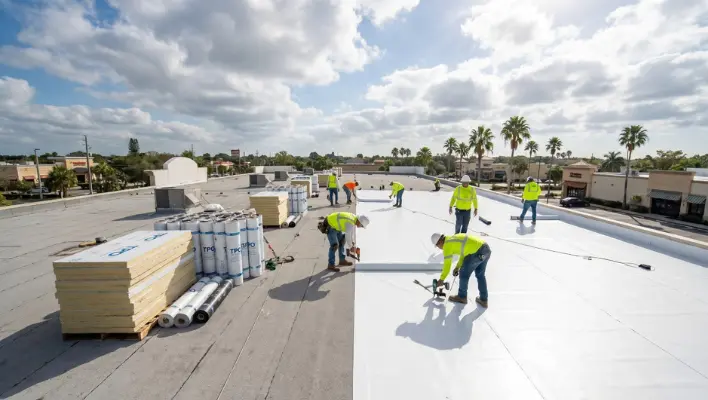
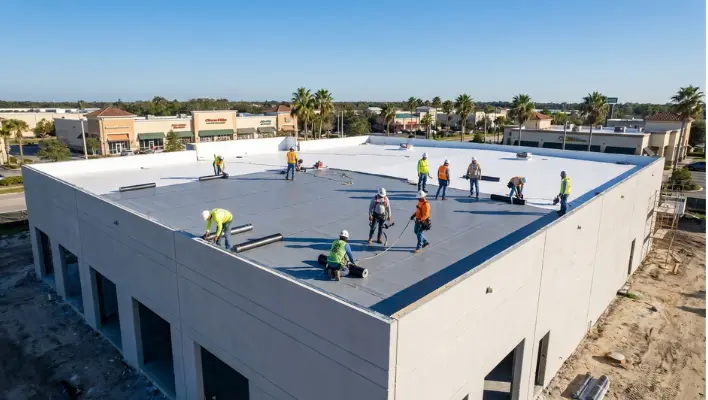
Today, the code does not allow a new roof over a roof that already has two or more layers. The owner has to tear off to the deck. The 9th Edition adds an exception to the existing-roofing rules in Section 706.3: where two roof coverings exist and the upper one is removed, the remaining covering can stay if it is adequate as a base for the new roof (FRSA).
In plain terms, some double-layer roofs that would have needed a full tear-off may only need the top layer removed. That can cut disposal cost and time on large buildings. Whether the lower layer is adequate still depends on its condition, so core samples and a moisture scan decide it, not the calendar. Our re-roofing page explains how we check a roof before recommending a recover.
A second revised exception lets existing vapor barriers or self-adhered membranes that are adhered to the roof deck stay in place and be covered with an additional membrane layer, instead of being scraped off.
More places that must be flashed
Section 1503.2.1 now lists roof edges, penetrations, changes in roof slope or direction, and changes between roof covering types as locations that must be flashed (FRSA). For low-slope roofs there is a new exception where the change in direction or slope is less than 25 degrees.
Each roof covering section, including built-up, modified bitumen, and single-ply, now states that flashing must follow the chapter and the manufacturer's installation instructions. Good contractors already work this way, but it is now written into the code for every system.
Lightning protection and coastal fasteners
A new Section 1510.8.6 adds flashing compatibility requirements where a lightning protection system is installed on the roof covering. Many commercial roofs in Florida carry air terminals and conductor cables, and the attachments are a common source of small leaks.
Engineers also point to new corrosion-resistant fastener and connector standards for buildings within 3,000 feet of the coastline (JRH Engineering). That matters for properties near the water in St. Petersburg and Clearwater, where salt already shortens the life of standard fasteners.
What does not change
- Wind design stays on ASCE 7-22, so design wind pressures are not being raised by this edition (Permit Place).
- The 2022 state law exemption from the 25% rule for roofs already built to the 2007 code or later is still law. Our repair page has a calculator for it.
- Leaks do not wait for code cycles. If water is coming in, repair it now and plan the bigger project separately.
What to do if you are planning roof work
- Ask your contractor which edition your project will be permitted under, based on the planned application date.
- If your roof has two layers, ask whether the new recover exception could apply once the top layer is removed.
- On coastal buildings, ask what fasteners and edge metal are specified, whichever edition applies.
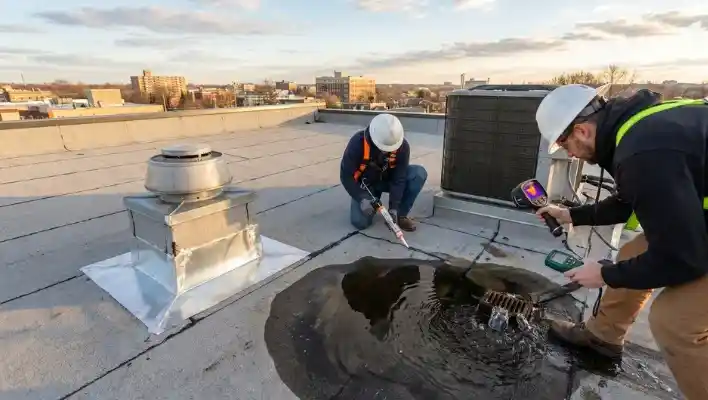
- Get a current roof inspection so the scope is based on the roof's real condition.