Florida shortened its property insurance claim deadlines in December 2022, and many building owners still work from the old timelines. If a storm damages your roof, the clock starts on the day of the loss, and missing it can bar the claim entirely. This is a practical overview, not legal advice. Your policy and your agent or attorney have the final word.
The deadlines
Senate Bill 2-A amended section 627.70132 of the Florida Statutes. It cut the time to report a new or reopened property insurance claim from 2 years to 1 year, and the time for a supplemental claim from 3 years to 18 months (Clyde & Co).
- New claim: notice within 1 year of the date of loss.
- Reopened claim: notice within 1 year of the date of loss.
- Supplemental claim: notice within 18 months of the date of loss.
The dates run from the date of loss, not the date you found the damage (Merlin Law Group). A leak that shows up in spring from a storm last October is already months into the window.
An example: if a storm damages your roof on October 15, 2026, notice of the claim is due by October 15, 2027, and any supplemental claim by April 15, 2028.
Commercial policies can be stricter
The statutory deadlines are the outer limit. Commercial policies usually also require prompt notice of a loss, and some set their own timelines for proof of loss. Read the conditions section of your policy, and report damage as soon as you know about it rather than waiting to see how bad it gets.
SB 2-A also ended assignment of benefits agreements for property policies issued on or after January 1, 2023, so a contractor generally cannot take over your claim. You stay in control of it, which also means the documentation is your job.
What to document after a storm
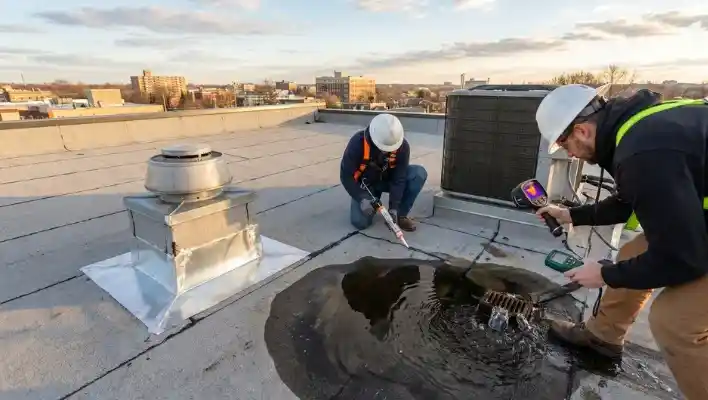
- Dated photos and video of the roof, the edges, and rooftop equipment, from a safe position.
- Interior damage: ceiling tiles, walls, inventory, and equipment, with the location of each leak.
- The date and the storm, with a note of the weather that day.
- Receipts for emergency work such as tarping or temporary patches. Policies generally expect you to prevent further damage.
- Your roof's condition before the storm: past inspection reports, maintenance records, and photos.
The last item is the one most owners lack. Adjusters look for pre-existing wear, and a dated report showing the roof was sound before the storm is strong evidence. It is one of the practical reasons to keep a maintenance program with a photo report after every visit.
How a roofer fits in
A roofer can make the roof watertight, document the damage with photos and notes, and meet your adjuster on the roof to walk through the findings. We do all three after storms, and our inspection page describes what a documented report includes. For coverage questions, talk to your agent or a property insurance attorney.