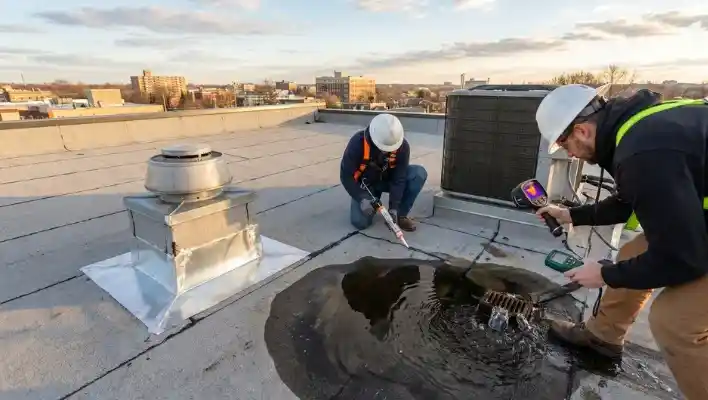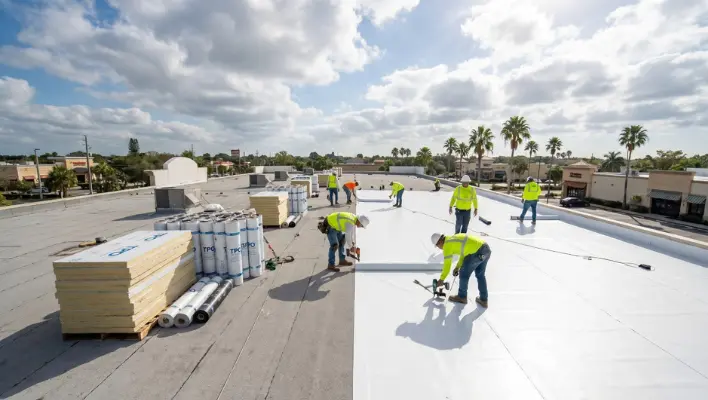
A dark roof in the Florida sun gets much hotter than the air around it, and some of that heat ends up inside, where the air conditioning has to remove it. A reflective roof sends more of the sunlight back. How much that saves depends on the building, and the best evidence comes from buildings that were measured before and after.
What the studies measured
Researchers at Lawrence Berkeley National Laboratory summarized experiments on individual buildings in California and Florida and found that reflective roofs reduced air-conditioning energy use by 10 to 50 percent, depending on the building and the climate (Heat Island Group, LBNL).
The Florida Solar Energy Center ran one of the clearest commercial tests at a 10,000 square foot school in Cocoa Beach. Its gray modified bitumen roof, with a solar reflectance of 23 percent, was coated with a white elastomeric coating that reflected 68 percent. Over two years of monitoring (FSEC):
- Chiller electricity use fell by about 10 percent, roughly 13,000 kWh a year.
- Summer weekday demand between 3 and 4 PM dropped by 5.6 kW, a 35 percent reduction.
- The coating's reflectance fell from 68 to 63 percent after the first year, as dirt built up.
The peak demand result matters for commercial buildings, because many utility rates charge for the highest demand in the billing period, and summer afternoons are when that peak happens.
What decides the savings on your building
- Roof area compared to floor area. A single-story warehouse or retail box gets far more of its heat through the roof than a multi-story office.
- Insulation. A well-insulated roof already blocks much of the heat, so a reflective surface saves less on top of it.
- Ducts and equipment above the ceiling. Ductwork in a hot plenum under the roof gains heat, and a cooler roof reduces that.
- Operating hours. Buildings cooled during the day, when the sun is on the roof, benefit most.
- Keeping it clean. The FSEC coating lost some reflectance in a year. Washing a white roof during maintenance keeps it working.
Ways to get a reflective roof
On a new roof, white TPO or PVC membranes are reflective from day one. We compare those systems on our roof replacement page. If your current roof is dry and sound, a reflective coating or a recover can add reflectance without a full tear-off, which is covered on our re-roofing page. A coating over wet insulation will not last, so a moisture check comes first.
Estimating it for your building
The simplest estimate starts with a year of electric bills, the roof area, and the current roof color and insulation. We can walk through those numbers during a free inspection. Large, flat, single-story buildings, like the warehouses we roof in Lakeland, are usually where the savings are easiest to see.